There are no items in your cart
Add More
Add More
| Item Details | Price | ||
|---|---|---|---|
A dedicated student recently asked me a million-dollar question: "Sir, what are the key points that one need to keep in mind while analyzing a mock?"
Fri Nov 21, 2025
This is the most crucial part of exam preparation. Taking a mock test takes 2 hours, but analyzing it should take at least 3. If you are just taking tests without analyzing them, you aren't practicing; you are just measuring your current level over and over again.Here is the step-by-step framework for analyzing a mock test effectively to maximize your score improvement.
1. The "3-Bucket" Technique: Don't just look at the total score. Break your paper down into three specific buckets. This is where the real data lies.
Bucket A: Attempted & Correct (The Efficiency Check) It feels good to see green tick marks, but don’t scroll past them yet. Ask yourself:
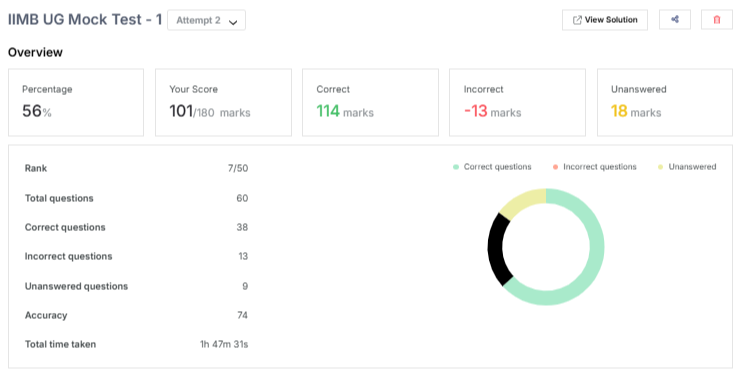
Pro Tip: If >50% of your errors are "Silly Mistakes," you don't need more study hours; you need more focus and mindfulness exercises.Bucket C: Unattempted (The Missed Opportunities)Why did you leave these?
Create a table with these columns:
Q. No | Topic | Why I got it wrong | Lesson Learned |
14 | Algebra | Calculation Error (2+3=6) |Write steps clearly, don't rush. |
22 | P&C | Didn't know formula | Revise Circular Permutation.
Review this log before you sit for your next mock.
We have created a spreadsheet of Error log for you - try it out!
Click Here - Error LOG

4. Monitor Your Stamina:
Look at your accuracy in the first 30 minutes vs. the last 30 minutes.
If your accuracy drops drastically at the end, you have mental fatigue. You need to build exam stamina by sitting for longer study sessions without breaks.
Summary Checklist for Your Next Analysis:
Vaibhav Goenka
Exam Strategist & Mentor (IIMB '27).
 Launch your Graphy